

Astronomers Could Lose Hubble Within A Decade, And NASA Is Running Out Of Options
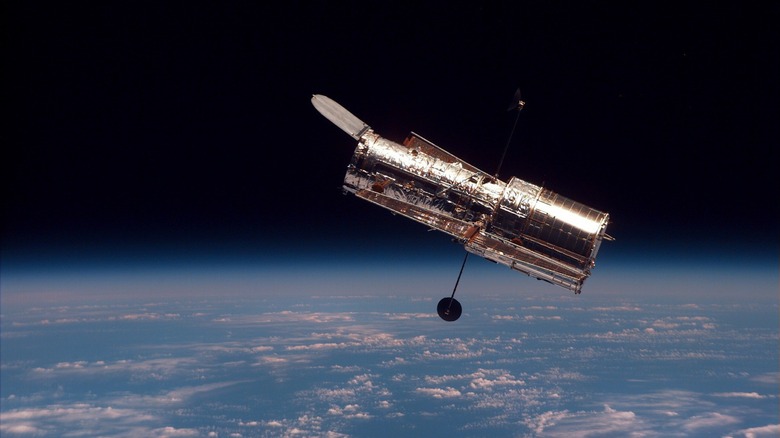
By any measure, the Hubble Space Telescope is an extraordinary piece of engineering. But if something isn't done soon, it could meet a fiery end. A joint project involving NASA and its European counterpart, ESA, the Hubble Space Telescope was deployed into Earth orbit in 1990. Ever since, it's been dazzling everyone from professional astronomers to wide-eyed young space enthusiasts with its extraordinary imagery and groundbreaking scientific discoveries. Indeed, since its deployment, Hubble has produced more than 1.7 million observations, which have been cited in more than 23,000 scientific papers. However, unless NASA intervenes in the next few years, the Hubble Space Telescope's decaying orbit will eventually bring it back into Earth's atmosphere, causing it to burn up during a high-speed descent.
But there are calls for it to be saved. NASA chief Jared Isaacman, for example, said in 2026 that Hubble "still has important science ahead of it," adding that extending the observatory's life would mean "more discoveries, more science, and more opportunities to expand our understanding of the universe."
The problem is that neither NASA nor ESA currently has a spacecraft capable of boosting Hubble into a higher orbit. The space-based observatory has no propulsion system of its own, and the only vehicle to have serviced it in orbit was the now-retired Space Shuttle, which last visited in 2009. If Hubble continues to lose altitude, experts believe it could re-enter the atmosphere around 2033 or 2034. NASA says that any mission to save it would need to take place by 2032, and it's asking for help right now.
NASA puts out the call to save Hubble
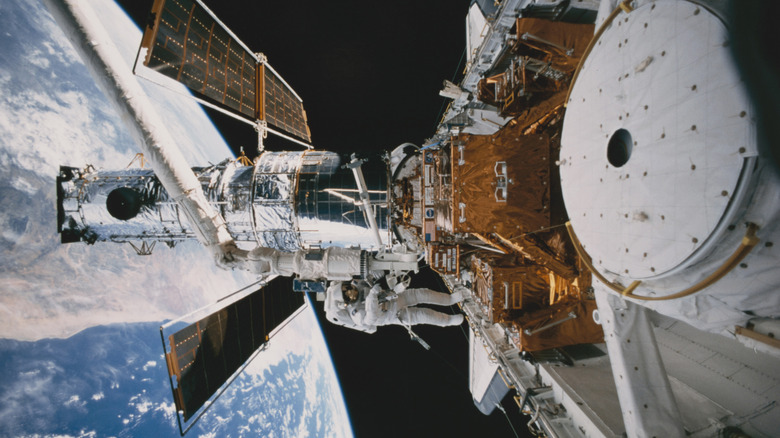
NASA, along with many in the astronomy community, believes that Hubble is worth saving. To that end, the American space agency recently issued a call for ideas from the private sector, outlining three possible options for the telescope's future that could be pursued individually or in combination. The first involves developing and deploying a spacecraft capable of capturing Hubble and boosting it to an altitude of at least 373 miles (600 km), while the second is a servicing mission to repair and upgrade Hubble's onboard systems and scientific instruments to extend its operational life while it remains in orbit. The third option is a mission to make sure that the observatory undergoes a safe and controlled re-entry into Earth's atmosphere at the end of its operational life.
Interestingly, NASA's Isaacman has a personal connection to an earlier Hubble rescue proposal. In 2022, while still a private astronaut and entrepreneur, Isaacman joined forces with SpaceX through the Polaris Program — his privately funded spaceflight venture — to explore the idea of using a SpaceX Crew Dragon spacecraft to boost Hubble into a higher orbit. While NASA agreed to study the feasibility of the proposal, the mission never took place. Now, as head of the agency, Isaacman is once again looking to the commercial space industry to find a way to save the iconic telescope.
Companies have until November 30 to respond to NASA's call, and it's still unclear whether SpaceX will put forward a new proposal. But why is the space agency so keen to save a telescope that's already been operating for more than 30 years? The answer is rooted in what Hubble has already achieved, and what it still has to offer.
Why is it worth saving Hubble?
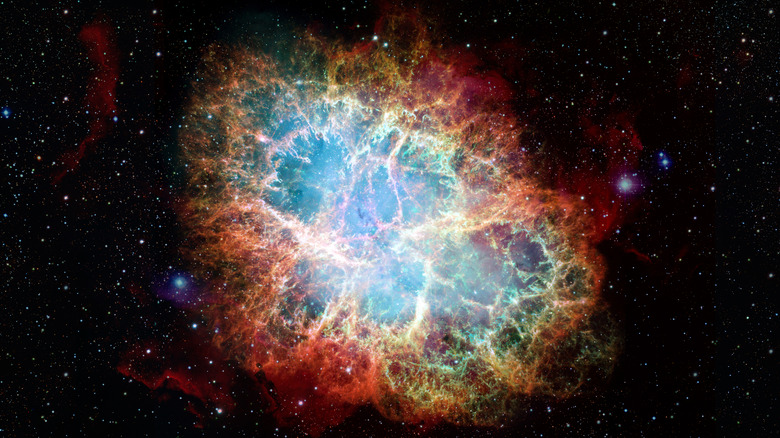
In a lifetime spanning more than three decades, Hubble has chalked up a string of achievements, sending back data that's kept astronomers busy for years while at the same time captivating amateur skywatchers around the world. And there's a clear unwillingness to see that flow of information come to an end anytime soon.
The trailblazing telescope made its name early on with the Hubble Deep Field observations in 1995, followed by the Ultra Deep Field observations in 2004, which together revealed thousands of previously unseen galaxies, enabling astronomers to study how galaxies formed and evolved across billions of years. Hubble's observations of distant supernovae helped establish that the universe's expansion is accelerating, while it also provided compelling evidence that supermassive black holes are common at the center of large galaxies. Among other breakthroughs, Hubble made the first direct measurement of an exoplanet's atmosphere, detecting sodium and opening up new possibilities for studying the atmospheric composition of worlds beyond our solar system.
And the workhorse telescope may still have a lot to offer. Despite the arrival of more powerful and more advanced space-based observatories like the James Webb Space Telescope, Hubble retains capabilities that its successor cannot replicate, in particular its ability to observe ultraviolet and visible light. From studying distant galaxies and the birth of stars to investigating the atmospheres of planets orbiting other stars, there's still plenty of science for the aging telescope to get to grips with. Allowing it to burn up in Earth's atmosphere sooner than necessary would mean losing a scientific resource, one whose capabilities may not be fully replaced for several decades.