

Power Surges Can Have An Unexpected Effect On Your TV - Here's How

Smart TVs are meant to stay plugged into an outlet. Even when they're off, they're usually in a low-power state. You may not realize it, but that puts your TV at risk, however small. At any time, a power surge can damage the parts inside your TV, including the power supply and capacitors; any parts that utilize electricity could be at risk. It's always a big deal when components fail, but data corruption because of a storage hardware failure can be particularly troublesome. And a power surge could easily damage the flash storage.
When data corruption occurs in a TV, the set may get stuck in a boot loop with the screen turning on but nothing showing, apps might not load, the system might experience frequent crashes, and other elements of the TV may stop working altogether. Moreover, some of these issues are ones you wouldn't necessarily attribute to the storage. Turning on the TV to a perpetually blank screen might have you thinking it's a display problem. If a power surge does physically damage the storage, it's likely not fixable without professional help.
You can try a factory reset or search the manufacturer's website for manual firmware update options; if possible, you could update the firmware to see if that restores the core data or at least refreshes it. Otherwise, the best defense happens before a surge. That's also why, outside of unplugging your devices, one of the easiest ways to protect your tech from power outages is to back up your important data whenever possible.
What is data corruption in a TV?

Modern smart TVs often include software and streaming technologies, designed to enhance your entertainment experience. Like any piece of software, it must be stored somewhere, which is usually a small NAND or flash chip inside the device, called flash storage. If that storage fails or is damaged during a power surge, that's when data corruption can occur. The data basically becomes scrambled, unreadable, or fragmented, meaning the TV can no longer access it and the resulting software and applications will no longer load.
Data corruption, by itself, is a fairly common issue that affects computers, mobile devices, game consoles, and anything else that uses a storage drive. A powerful surge can effectively fry components inside a TV, including the storage, while minor, repeated surges could damage it as well, or cause components to overheat. When a power surge physically damages components, anything from the internal storage to the mainboard, there's not much recourse besides having the parts repaired, DIY or professionally, or replacing the TV.
Why do power surges occur and how do you prevent them?
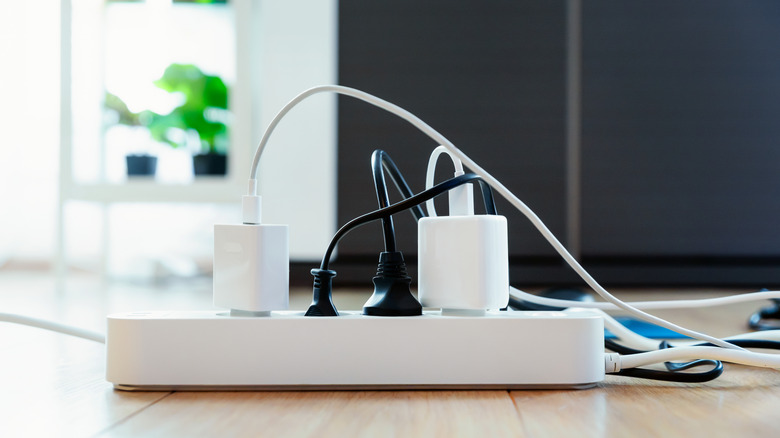
In American Homes, outlets should theoretically supply a consistent 120 volts, but alternating current (AC) realistically fluctuates across a range from 0 to 169 volts. Most electronics are designed to handle these minor changes; however, huge, sudden spikes are a different story. Certain events can make that voltage spike well above the peak 169 volts, which is when a power surge occurs. You're likely familiar with a lightning strike, which is one way a surge happens, but there are actually many other, more common events that can cause them.
Surges can originate from the utility company during maintenance, or may occur across the grid for various reasons, like a blown transformer or infrastructure failures. They can also happen in your home due to electrical failures or simply when high-power appliances kick on or off, like an air conditioner. Often, when you see a breaker tripped, or actively trip, it's due to a power surge. Surge protectors are your best solution.
A surge protector is inherently designed to keep your electronics safe from unexpected power events, hence the name. It's always a good idea to plug your most valuable devices into a reliable one, though you should look for heavy-duty options with better protection. Heavy-duty options have built-in breakers to divert the surges; this is why some power strips have a reset button. You can also unplug your most important electronics during a thunderstorm, though it's not always feasible to unplug everything manually. That's why surge protectors are a great help.