

The Next Generation Of 3D Printing Is Here, And You Can Build It Right Now
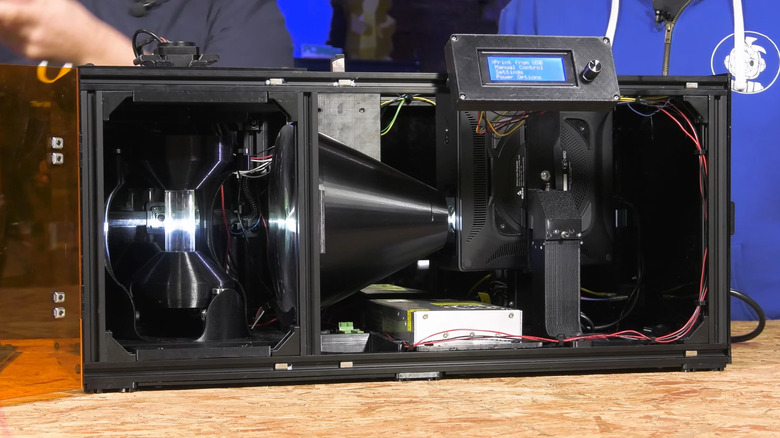
For makers who know the pain of waiting hours for a desktop 3D printer to lay down hundreds of millimeter-thick plastic lines one by one, a faster solution to additive manufacturing would be most welcome yesterday. Standard consumer manufacturing at the moment forces users to compromise between build speed and surface resolution, making operators choose between visible layer lines or lengthy post-processing work.
But there's been a breakthrough in open-source hardware and software that's going to completely upend how hobbyists and engineers create physical objects. The OpenCAL volumetric 3D printer brings Computed Axial Lithography out of high-end university research laboratories and kicks open the doors of accessibility for makers. We can now build a portable, maker-friendly volumetric 3D printer capable of producing fully formed solid objects in just a few seconds. Yes, you read that right.
Unlike traditional additive 3D printers, which can be either resin or filament 3D printers, volumetric printing solidifies entire three-dimensional geometries simultaneously without moving along a vertical Z-axis. Originally requiring massive laboratory setups, this technique has now been condensed down into an open-source build that fits neatly inside standard checked luggage. The system relies on a blend of off-the-shelf electronics, custom software, and specialized photopolymer materials to enable high-speed digital light processing. The contained nature of OpenCAL looks like it could also avoid some of the health risks that current 3D printers have.
Computed Axial Lithography creates 3D shapes in seconds
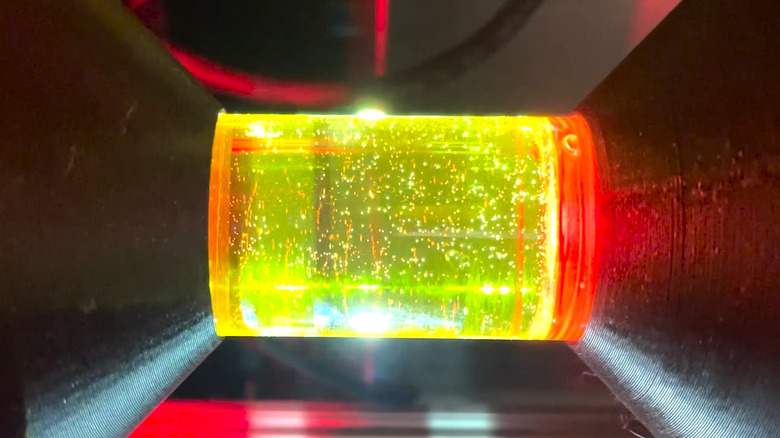
Traditional desktop manufacturing builds an object layer by layer, otherwise known as additive manufacturing. But Computed Axial Lithography approaches fabrication from an entirely different mathematical dimension. Instead of extruding hot plastic or curing flat cross-sections onto a rising build plate, OpenCAL rotates a glass cylinder filled with viscous resin while projecting a video through the container. A compact projector shines 450-nanometer blue light through the spinning liquid, delivering varying intensities of light patterns from multiple angles. As the container rotates, the intersecting light energy accumulates a specific radiation dose only in predetermined coordinates, hardening the liquid resin into a solid part in one go.
This simultaneous light accumulation delivers unprecedented production speeds compared to standard desktop systems. In a demonstration of the portable rig posted on YouTube, researcher Taylor Waddell showcases a fully formed miniature space shuttle created in 20 seconds. Because parts harden without sequential slicing, finished components avoid the mechanical weak points and layer lines typical of standard prints. Once exposure completes, operators clean away uncured resin using high-speed rotational spinning or an isopropyl alcohol bath before placing the component in water for a final ultraviolet light cure under natural sunlight. This post-processing routine is very similar to existing wash-and-cure solutions used in resin printing today.
Standard off-the-shelf components

Constructing an OpenCAL volumetric 3D printer relies on accessible hardware, basic hand tools, and a straightforward assembly process. A Raspberry Pi single-board computer manages the system, driving an attached LCD and streaming continuous MP4 video files directly to the blue laser projector without needing complex G-code translation. Without a doubt, this is one of the most creative ways to use Raspberry Pi hardware. Alignment is a top priority here, too, since the printer locks in alignment with a custom three-axis screw adjustment mount to position the light precisely at the cylinder's center point.
To keep home fabrication safe, the project partnered with Formlabs and MatterHackers to distribute pre-mixed photopolymer resins at cost, preventing users from handling volatile chemicals. The liquid polymer reacts exothermically during curing, generating moderate heat during normal print cycles. But Taylor Waddell warned that exposing bulk resin vials to direct sunlight can trigger runaway chemical reactions reaching 230 degrees Fahrenheit.
All that said, building an OpenCAL 3D printer carries an estimated price tag of $1,400 for just the materials, with the laser projector accounting for most of that expense. However, anyone can download firmware from the OpenCAL GitHub page and follow step-by-step guides from the official OpenCAL build documentation.