

5 Of The Best Big OLED TVs For A Home Theater
We may receive a commission on purchases made from links.
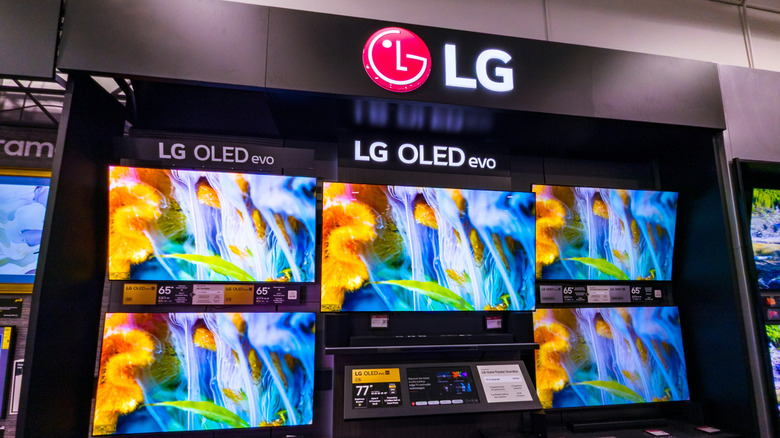
It's hard to replicate the cinematic experience of watching a movie in theaters, but a gargantuan OLED TV is one of the best substitutes we can think of. Instead of LED backlighting, OLED panels are made up of millions of self-emissive pixels, each of which is individually controllable. This is how these industry-lauded TVs are able to deliver unbeatable black levels and rich colors. It's the kind of picture quality that filmmakers and content creators want you to see, and there are plenty of massive screens on the market.
When we say "massive," we're talking anything bigger than 65 inches. OLED manufacturers like LG offer 77 and 83-inch sets, as well as a few 97-inch beasts with equally beastly prices. You'll also be able to find Samsung and Sony OLEDs over the 70-inch threshold, which bodes well for those who want to compare multiple models. We should also mention that OLED TVs are far better at glare reduction than they used to be, thanks to anti-glare technology and enhanced panel brightness.
Whether you're considering wall-mounting a huge OLED or investing in a premium home-theater setup, we thought we'd help whittle down your TV options by hand-picking the best of the best ourselves. So without further delay, here's our roundup of the five best big OLED TVs for a home theater.
LG 83-inch G6 Series
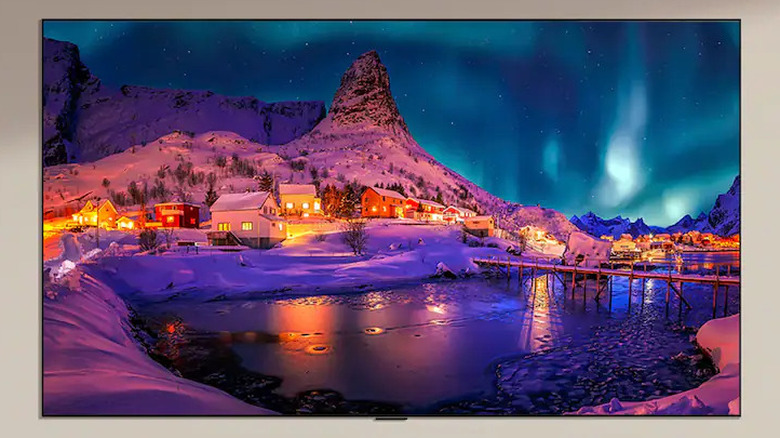
No OLED TV list would be complete without at least one LG TV on the docket. If you value picture quality and visuals, the $6,500 LG 83-inch G6 Series can be a good fit for you. The G6 uses LG's Primary RGB Tandem Panel 2.0 and Hyper Radiant Technology to boost brightness, especially for HDR content. But OLEDs do their best work in a dark room, and this is when the G6's inky black levels and wide color gamut are on full display.
LG's Alpha 11 Gen 3 AI Processor also does a good job at upscaling lower-quality content, so everything from your old DVD collection to over-the-air SDR broadcasts looks sharp and detailed. And thanks to full HDMI 2.1 connectivity and VRR support, console and PC gaming is nearly lag-free. The G6 even has a native 120 Hz refresh rate that can go up to 165 Hz, so you can expect smooth motion while gaming.
CNET took a close look at the LG G6 Series and gave it an 8.7 out of 10 score. The reviewer did a side-by-side comparison with several TVs, including last year's G5 Series, and thought the former was "demonstrably better... in terms of shadow detail, anti-reflectivity, and brightness in games." While there's a bit of a green tint with off-axis viewing (when you're not sitting centered with the screen), this is a common issue with OLEDs, and it's only noticeable at extreme angles.
Samsung 77-inch S95F
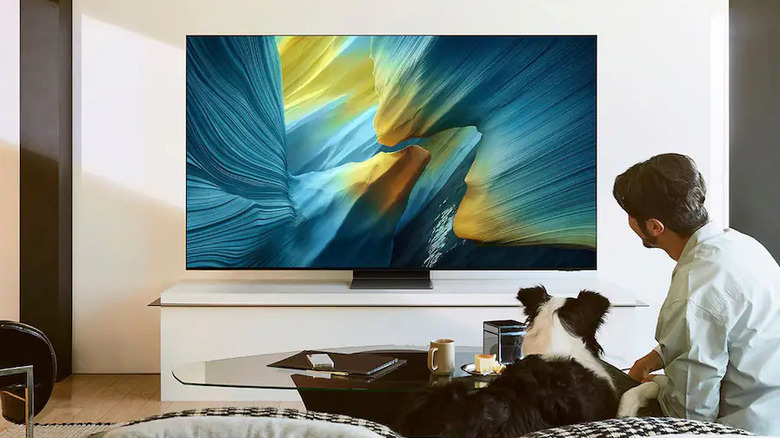
We're all about flagship OLED TVs, and one chart-topper from 2025 you can still get your hands on is the $3,700 Samsung 77-inch S95F. In lieu of a traditional WOLED panel, this model uses a QD-OLED display, resulting in higher peak brightness than what the Samsung S95D delivered in the previous generation. Right out of the box, the S95F does a decent job at replicating a wide range of colors, with full coverage of the Rec.709 color space and 99.95% coverage of DCI-P3. If you want to enjoy the true color accuracy of the TV, you can switch to the built-in Filmmaker Mode.
Speaking of motion, the S95F boasts a native 120 Hz refresh rate that can reach 165 Hz with Motion Xcelerator, as well as VRR and ALLM support, making it worth considering for console and PC gamers. The TV's anti-reflective coating does a nice job at reducing glare, allowing the S95F to hold its own in a brightly lit room. TechRadar took this premium Samsung for a spin and gave it a perfect 5/5 score, praising its brightness, colors, glare reduction, and gaming tech. The reviewer dinged the TV for its lack of Dolby Vision support, though, which continues to be a Samsung annoyance.
Similar to the LG G6 Series, the S95F also doesn't support DTS audio formats. That said, the TV's onboard speaker system is better than average, so you may not even need a soundbar for this 77-inch OLED. This is a Samsung TV that houses I/O on its Slim One Connect Box, including four HDMI 2.1 ports, audio out, USB, and Ethernet. While availability is decreasing, Best Buy still sells the 77-inch S95F brand-new, and user feedback earned it a 4.7 out of 5 stars (based on 200 reviews).
LG 77-inch C5 Series
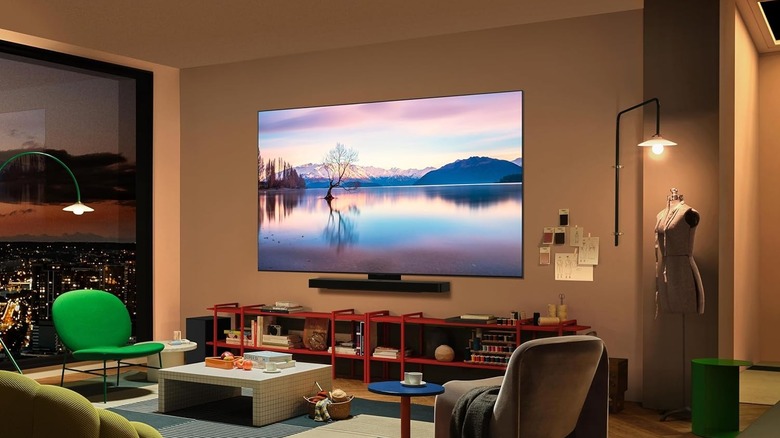
The $2,000 LG 77-inch C5 Series is an industry-lauded OLED that hit the market in 2025, but you'll still be able to get your hands on one from multiple retailers. Unlike the flagship G6 Series we mentioned above, the C5 doesn't use LG's Primary RGB Tandem Panel 2.0 tech, so this OLED isn't as bright. That said, you can still expect vibrant colors and punchy highlights, especially when watching or playing HDR content. Unfortunately, HDR10+ support is missing from all LG TVs, but the C5 does work with Dolby Vision, HDR10, and HLG formats.
On Amazon, the 77-inch C5 took home a 4.6 out of 5-star rating (based on over 1,200 reviews), and most feedback was at the 5-star tier. People love the TV's picture quality and intuitive user interface, but a few users thought the TV's webOS software performed a bit on the wonky side. A lot of folks also really dislike the remote that comes with it. Over at What Hi-Fi, the C5 earned top marks, with compliments paid to its "rich, solid, and engaging picture that balances vibrancy and authenticity."
Other noteworthy features include a native 144Hz refresh rate, full HDMI 2.1 connectivity, VRR and ALLM support, and LG's webOS for all things apps, streaming, and user interface-related. The manufacturer also claims you'll get up to five years of webOS updates. The LG C5 may not be a perfect OLED, but it's a solid runner-up to both the G5 Series (LG's 2025 flagship) and G6 Series.
Samsung 83-inch S90H
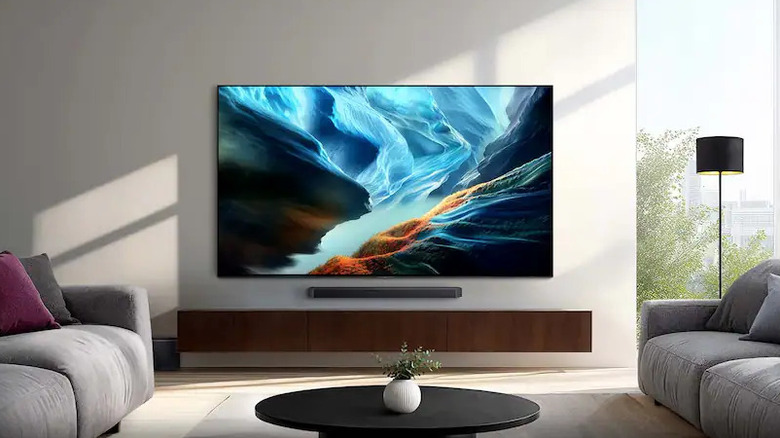
The $5,300 Samsung 83-inch S90H is one of the newest Samsung OLEDs on this list. Laurels range from "colors are bright and vibrant" to "outstanding reflection handling" for this model, which sits just one rung below the manufacturer's 2026 flagship, the S95H. Surprisingly, Samsung decided to use a traditional WOLED panel for the S90H lineup, instead of QD-OLED tech. They also decided to do away with the One Connect Box, so all inputs are housed on the back of the S90H.
As far as brightness goes, at times, the S90H performs more like a midrange LED than an upper-tier OLED. The TV's strong reflection handling prevents lamps and window light from ruining afternoon TV time, and it delivers impressive peak brightness when switched to HDR. The only drawback is that black levels appear raised when there's a lot of ambient lighting, but that's easy enough to mitigate (turn the lamp off, and invest in some blackout curtains).
Our friends at Techlicious loved the Samsung S90H, proclaiming, "[t]he S90H comes with a host of features that make it a great choice for gamers, sports enthusiasts, and movie buffs alike." The 83-inch size also scored a 4.9 out of 5 stars on Samsung's site, and reviews mention that the 2026 version of Tizen OS (apps, streaming, and user interface) performs much faster than last year's software.
Sony 77-inch Bravia 8
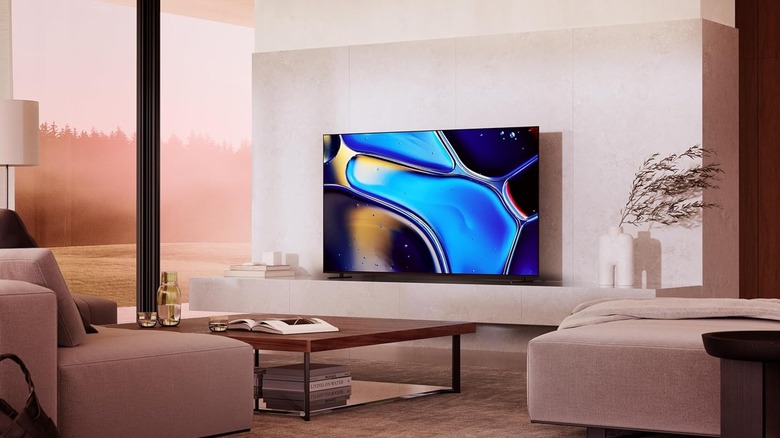
Lastly, we have the $2,300 Sony 77-inch Bravia 8, which is actually a 2024 upper-tier OLED that you can still nab for the time being. Amazon shoppers gave the 77-inch size a 4.1 out of 5 stars (based on over 460 reviews), and TechRadar gave it a 4.5 out of 5-star rating. Sony opted to use a traditional WOLED panel on this model, as opposed to the QD-OLED screen found on the older Bravia A95L. This means the Bravia 8 isn't as bright as the other sets we've talked about, but it makes up for it with a wide color gamut and vibrant, lifelike tones.
The Bravia 8 supports HDMI 2.1 on two of its inputs, but one of these connections is also the eARC port. This isn't a deal-breaker, but it could make things a bit more challenging when you're trying to connect a home theater soundbar to the TV. Other noteworthy features include VRR and ALLM support, great HDR support (it's only missing HDR10+), and a robust but intuitive user interface, courtesy of Google TV. You can even use Google Assistant to search for movies and shows, change inputs, or control smart home devices.
At the time of writing, the 77-inch Bravia 8 is available for its full list price of $2,300, but it's not half bad. But if you don't mind holding out for a discount, Sony sometimes drops the price as low as $2,100. It's also worth mentioning that Sony released a variant of the Bravia 8 – the Bravia XR8B – which doesn't include Sony's XR Contrast Booster.
How we chose these big OLED TVs

Enormous OLED TVs are some of the best-looking sets on the market, and if you plan on keeping yours in a dark room, we think you'll be floored by the black levels and colors that LG, Samsung, and Sony bring to the table. When choosing the five TVs that made it on this list, we did our best to include a range of 2024-2026 TV options, and used professional, hands-on reviews and user feedback to help inform our selections.
We also didn't include any OLED TVs from Panasonic or Philips, as the former has exited TV production altogether and existing models are too tough to find, and the latter only offers limited 65-inch OLEDs in the U.S.