

Do You Need To Take Off Your Headphones At A TSA Checkpoint?
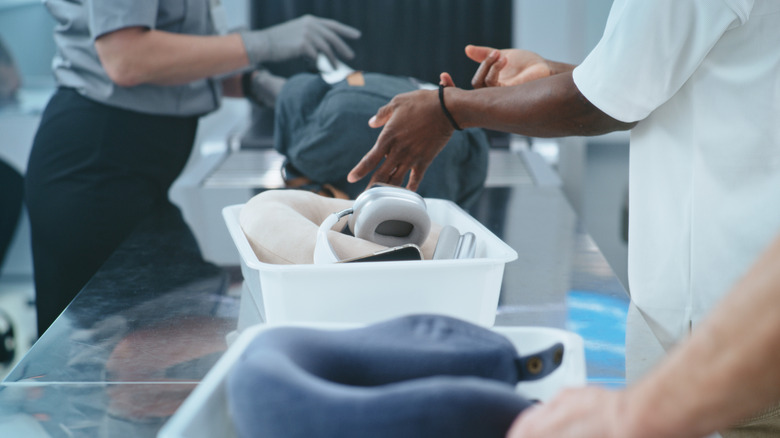
Wireless headphones, including over-the-ear models and earbuds like Apple's AirPods, are commonly seen in public, as many smartphone users rely on these accessories to listen to their favorite content and talk on the phone while they're on the go. Some people may wear their headphones throughout the day, even when they're not listening to music, to the point where they might forget to take them off when the situation calls for it.
TSA checkpoints are one scenario where some headphone users might not take off their devices while preparing for the security check and moving through the checkpoint, but that's not the proper procedure. Instead of wearing the headphones while going through the TSA checkpoint, users should place them inside the bin with all their belongings for screening. The only exception concerns people who are deaf or hard of hearing, who may keep using their hearing devices while passing through the checkpoint. But even then, additional screening may be applied.
The TSA allows users to bring headphones on planes, including carry-on bags and checked bags. Most people will probably want to use the headphones during the flight, so they'll have them with them, or in their carry-on. While TSA documentation notes the traveler's right to carry these devices, it also says that it's up to the TSA officer to decide whether the device is allowed through the checkpoint. The documentation does not say whether the user should place the headphones in the bin when passing through the checkpoint, but TSA agents may instruct users to do so. If they allow a user to pass through the checkpoint with headphones on, the metal components inside the device may sound an alarm, which can lead to additional screening.
It's not just about the alarm going off

If the metal-detecting alarm sounds, a TSA officer can conduct an additional screening, which may include a pat-down and inspection of the headphones that may have triggered the alarm. Users may be required to pass through the checkpoint again, without wearing the headphones, which may be placed in a separate bin. The X-ray machine will not harm your headphones or other electronic devices, if you're concerned about damage. But there's another reason why travelers should avoid wearing headphones while passing through TSA checkpoints that has nothing to do with triggering an alarm and slowing down the queue. Former TSA agent Caleb Harmon-Marshall told Business Insider that he would never wear headphones while going through security checks because he wants to be "very mindful" of his surroundings.
TSA checks can be very stressful for both the traveler and the officer, especially in crowded airports. Wearing headphones can make it difficult to hear instructions from TSA agents, even if you stop playing music or podcasts while you approach your turn to go through the security check. You may be an experienced traveler who is very familiar with TSA screening, but if you can't hear a particular instruction, you'll slow the security check for yourself and others behind you. That's why it's a good idea to take off your headphones and place them in the bin or your bag while you pass through the checkpoint.
Removing the headphones at TSA checkpoints will give you another benefit if you wear AirPods or other headphones all day. You'll give your ear a break from the headphones, allowing ventilation to the ear canal and helping to improve ear health.
The only exception

The TSA online documentation has a section for deaf or hard-of-hearing users where it explains that people with hearing disabilities should inform the TSA officer that they're "deaf or hard of hearing and require assistance with the screening process." The same page says that hearing aids or cochlear implants should not be removed during the security check, warning that additional screening and inspection may follow.
Since Apple's AirPods Pro also offer hearing aid functionality, the devices may qualify as hearing aids. However, unlike hearing aids and cochlear implants, which indicate a hearing problem, the AirPods Pro don't signal that the wearer may have hearing difficulties. In this case, the user should inform the TSA agent that they're using the AirPods Pro as a hearing aid. Even then, it'll be up to the agent to allow the use of the wireless headphones during the security check. The same goes for other headphones that can offer hearing aid functionality.
The Canadian TSA (CATSA) says that people with hearing disabilities can be screened without removing hearing aids or devices, but these will be inspected visually. The agency notes that some hearing aids may be affected by X-ray and metal detectors, advising users to ask for full body scans or physical searches. The Australian Home Affairs office notes that travelers do not need to remove hearing aids (cochlear implants, external components for cochlear implants, and middle ear implants), and that the devices will not be affected by metal detectors and body scanners.