

The Small Gadget Experts Say You Should Always Keep In Your Refrigerator
We may receive a commission on purchases made from links.
A refrigerator's singular job in any given household is to keep things cold, and nobody would blame you for assuming that, so long as it's plugged in, it will continue to do that, especially if it's from one of the most reliable brands. However, there's an inherent risk in that little assumption: if your fridge ever malfunctions and loses its coldness, even a bit, you could experience food spoilage that could endanger your and your family's health. The best way to prevent this from happening is to install a thermometer in your fridge, preferably a smart thermometer.
Whether it's due to motor problems or improper sealing, it can be a little difficult to discern when your fridge isn't functioning properly at a glance, even if you stick your head in it. You can't tell whether it's at its optimal cooling temperature based purely on vibes, after all. Placing a thermometer in your fridge will give you a concrete, empirical data point that you can consult quickly and easily. If that thermometer is a smart thermometer that can send notifications to your phone whenever there's a sudden change in temperature, all the better.
A smart thermometer will help you catch problems early
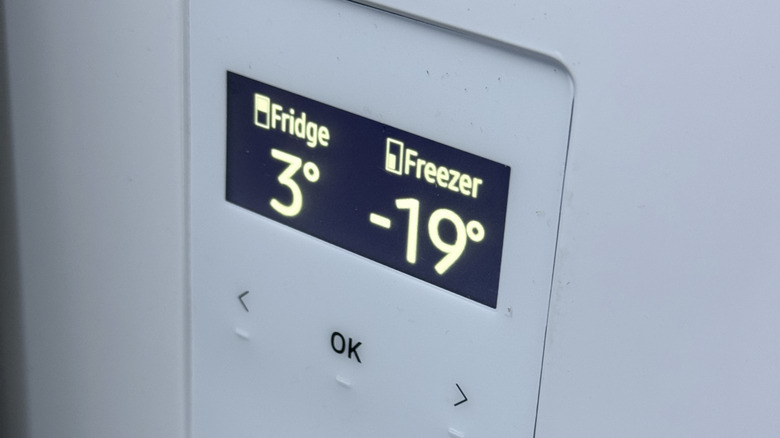
The ideal science-backed temperature for your fridge is approximately 40 degrees Fahrenheit or below to keep food fresh, preserved, and most importantly, protected from marauding bacteria. The problem here is that, while some sufficiently fancy refrigerators do have direct temperature control and display interfaces, many merely have generic "coldness" dials that don't actually tell you what temperature the fridge is at. Even if you've set your fridge to its coldest temperature, without a display, you can only assume it's at that temperature, as it's effectively impossible to know what the actual temperature is just from feeling it. You could certainly tell if your fridge has failed completely, as it wouldn't be cold at all, but by then, it'd be far too late for your food.
This is where a standalone thermometer comes in. If you just leave a thermometer on one of the shelves of your fridge, you can immediately check the temperature by just picking it up and looking at it. If the coldness feels off, you can know right away. A simple mercury thermometer will work for this purpose, though if you're really concerned, a smart thermometer like the YoLink Smart Temperature Sensor is an essential smart home gadget you should be using. This kind of device also provides immediate temperature readouts, but it can send those readouts directly to your phone, so you don't even need to open the fridge. You can also program alerts to go out in the event that the temperature begins shifting dramatically. If it suddenly becomes noticeably warmer in your fridge, you can start moving food out right away before things start spoiling.