

35 States Have Banned Smartphones In School - Here's Why
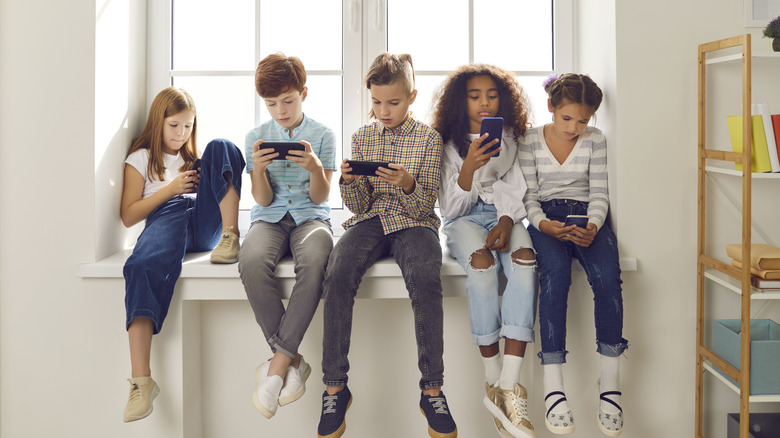
Smartphones seem to be always on hand for every adult and every student. However, students carrying around and using their phones in schools have prompted at least 35 states, as well as the District of Columbia, to ban smartphones in some capacity. Concerns over distraction from learning, impacting student mental health, and everyday smartphone risks are often cited to advocate for these bans, though opponents point out that there is usually a safety reason parents put phones in the hands of their children.
There are 24 states that have a straight bell-to-bell restriction on smartphones in schools. That is, they are not allowed at all from the time school starts to the time school ends. Some of these states include Alabama, California, Texas, and New York. For Florida, Georgia, and Hawaii, the bell-to-bell ban is only effective for grades K-8. There are 10 other states that only ban smartphones when it's instructional time in the classroom, including Indiana, Utah, and Nevada. These policies can be complex, often having exceptions for certain cases and allowing a certain level of teacher discretion.
Such policies are fairly new, with the oldest being signed in 2023 in Florida. It started out as only an instructional time smartphone ban. In 2025, the policy was updated to have a bell-to-bell ban for elementary and middle schoolers only while keeping the instructional time ban for high school students.
The smartphone ban has seen criticism

Not everyone is in agreement that these school policies are a good idea. There was even a study in the United Kingdom that said parents shouldn't worry so much about their kids' screen time limits. Critics of these policies, which include some parents, argue that the whole purpose of parents paying for smartphones for their children is for safety reasons. They are able to text or call if they need help. The parent can get a hold of them quickly in the event of an emergency. Completely taking away that link between parent and child misunderstands why these are in the hands of kids in the first place.
There is also the problem of the importance of digital literacy. These students will grow up to become adults who may work fully remotely or at least have the office revolve around digital technology and communication. They will become adults who navigate an online world of shopping, following news, and dealing with AI. Students need to learn how to handle online communication, understand how to identify misinformation, and learn how to handle the ever-evolving AI landscape. Universal smartphone bans in schools could be missing out on proper ways to teach students how to navigate the digital world as healthy functioning adults.
Smartphones pose a fair share of problems for students
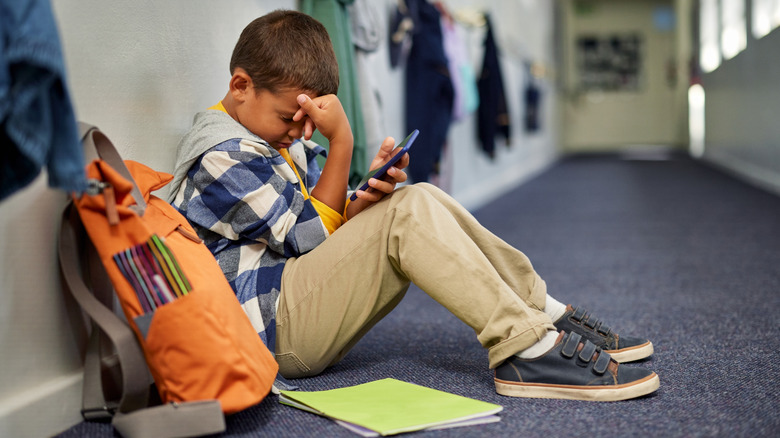
Despite criticisms of these policies, they do exist because of concerns around how smartphones impact students. Some teachers advocate for these bans because they help students focus more on instruction, interact more with their peers, and help them achieve better grades. After all, there is evidence that ChatGPT is making us dumber, so students avoiding AI usage to learn on their own is not a bad thing. These policies can also limit cyberbullying, at least during school hours, since students won't be able to look at their screens or send messages to one another.
Screen time usage for children and adolescents has been linked with risks of heart disease, high blood pressure, and obesity. This is because students staring at their screens are not physically active to promote a healthier body. Students using social media frequently have higher rates of depression, anxiety, loneliness, and an overall low sense of self-esteem.
Talking with AI chatbots has also recently reared its head as a potential problem, with the majority of teens at least trying these chatbots out. They are used as a replacement for human friendship and for human romance. The social impact of this can be concerning. Although it can be equated to a way of journaling the complex feelings that come with being a teenager, it also may limit peer-to-peer interaction while at school for developing social skills.