

The Titanic's Final Moments Have Been Recreated With Supercomputer Precision
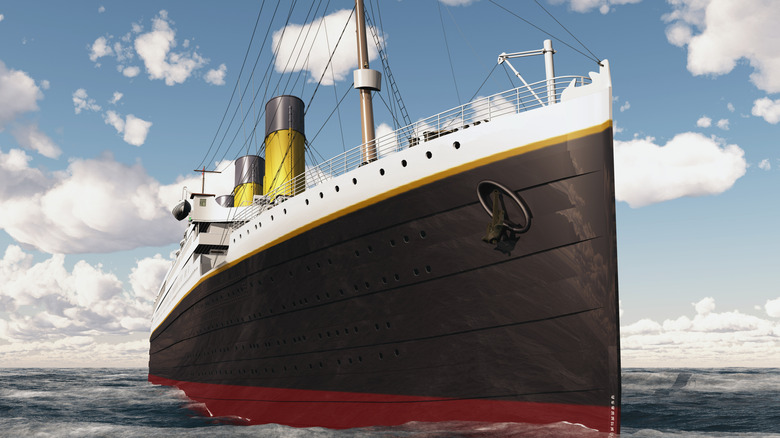
Dubbed as an "unsinkable" ship when it set off on is maiden voyage in 1912, the RMS Titanic earned a place for itself among some of the worst maritime disasters, with the ship ending its voyage less than 400 nautical miles off the coast of Newfoundland, Canada after an iceberg struck its starboard side. Over the years, we've seen various attempts to dig deeper into what happened to the Titanic as new artifacts popped up, and even reports of a Titanic replica being under construction. Now, scientists have taken their research into the Titanic and its monumental sinking even further, recreating the ship's final moments with the precision of a supercomputer as part of a new study published at the end of 2025.
The new recreation was made possible thanks to all the data that has been gathered around the RMS Titanic's sinking over the years. This includes data from the original discovery of the ocean liner back in 1985, as well as more recent data which has been captured by advanced deep-sea submersibles. This data has enabled extensive surveys of the wreckage and the damage sustained to it by the pressure of sinking over 12,000 feet beneath the surface. While it didn't implode like a submarine might, it did see significant damage after the initial incident.
The core goal of the researchers was to reconstruct the entire event, from the time of iceberg impact to the flooding of the ship's lower decks, and then the eventual severing of the ship in two before it sank beneath the surface. All in the name of validating historical testimonies about the ship's demise.
Verifying and validating the data from the Titanic disaster
Before they could start modeling the ship's sinking, though, the researchers needed to look at all the data that had been presented so far. Over the years we've seen various expeditions to the Titanic's wreckage, providing more insight into the damage that the ocean liner might have experienced in those final moments. Despite all of the data that has been gathered over the years, there are still questions that remain unanswered, such as the precise damage sustained by the ocean liner's side when it struck the iceberg, as well as the progression that the water followed when flooding the ship's lower compartments. Additionally, the researchers say one of the biggest questions they wanted to try to answer was whether or not the Titanic could have survived a head-on collision with the iceberg instead of a glancing blow.
They started with witness testimonies and the reports from various forensic analyses of the wreckage. From there, they looked at the exact structural specifications of the ship, including the arrangement of compartments along the ship's belly. Next, the researchers figured out the average speed of the Titanic at the time — roughly 22 knots, which was considered full-service speed — and then began to simulate based on the eyewitness reports about the iceberg and damage sustained to the ship, along with data from other surveys of the wreckage.
What the analysis says about the Titanic tragedy
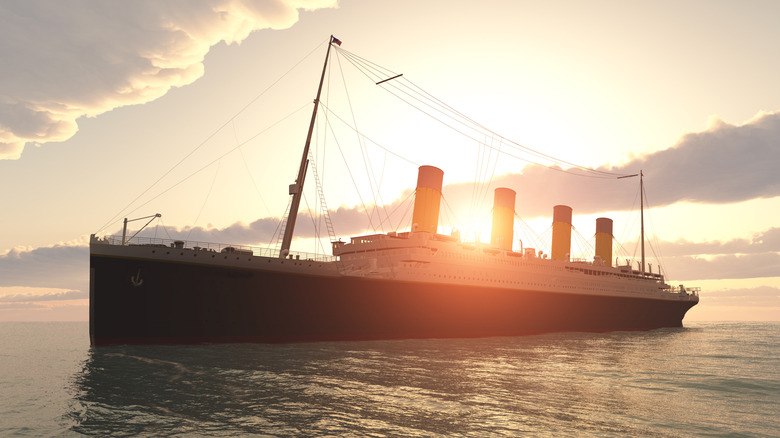
Based on all the data, the researchers created a step-by-step outline of how quickly water filled the compartments across the ship, with a maximum estimate of 243 tons per minute flooding through the ship within the first hour (a minimum of 138 tons per minute was estimated). The Titanic, which was considered the peak of naval design and technology at the time, was equipped with five ballast pumps and three bilge pumps, all designed to help discharge water that made it into the ship. However, these systems could only discharge around 11.4 tons of water per minute. That means that even at the lowest estimate, the Titanic's systems could not have kept up with the intake of water.
The researchers completed their simulation by adding in the details needed to properly reconstruct the iconic breaking in two that the Titanic experienced. When looking back at everything and comparing it to the surveys of the wreckage and the final resting places of the ship's two pieces, the simulation proved consistent with that imagery and sonar mapped topography.
They also ran simulations to see how the Titanic might have fared had it hit the iceberg head on and found that the ship most likely would have remained afloat, as only four compartments would have flooded compared to the six that flooded with the grazing of the iceberg. Additionally, lowering the ship's speed before impact likely would have further lessened the flooding during a head-on collision.