

Type 45 Destroyers Are Deploying New DragonFire Lasers To Shoot Down Drones

The United Kingdom's Royal Navy announced a £316 million deal (roughly $414 million) to equip its Type 45 destroyers with state-of-the-art laser weapon DragonFire. This investment marks a major step toward bolstering NATO's drone defenses and delivers Europe its first high-powered defense system with lasers. It's also seen as a major coup for NATO defenses, looking to adapt to an ever-evolving technological landscape.
Over the past few years, drones have become a growing problem for global military forces. The pilotless vehicles, widely used in the Russia-Ukraine war, have become a major weapon for both sides, accounting for up to 80% of all casualties by early 2025. Cheaper and less risky than their piloted counterparts, unmanned air, sea, and ground vehicles have steadily become existential threats for traditional defense systems, partly due to the disproportionate costs of deploying and defending against them. As such, the technology has rapidly spread, becoming a popular reconnaissance and attack tool for everyone from drug cartels and Burmese rebels to the Israeli military. Even the FBI is looking to use unjammable drones.
The U.K., for its part, saw firsthand the challenges of developing anti-drone defenses in April 2024, when its Type 45 warship HMS Diamond fended off swarms of Houthi-controlled drones attacking shipping vessels passing through the Red Sea. The attack, which the destroyer countered with its Sea Viper missile system, Phalanx machine gun, and 30mm cannons, underscored the inefficiencies of modern defense systems against drone attacks and the necessity of investments in counteracting the technology. Developing a diverse range of responses is critical to forming well-rounded, adaptable defenses, particularly as military drone technologies advance. For instance, Russia's jet-powered Geran-3 drone can bypass electronic defenses, so protecting against it requires diverse anti-drone systems.
What the DragonFire is and how it works
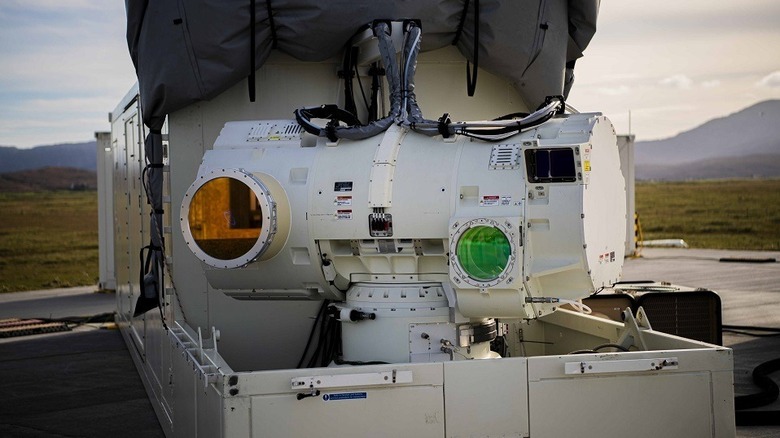
Announced in a Ministry of Defence press release in November 2025, the Strategic Defence Review's £316 million contract will see defense company MBDA UK install the first DragonFire laser onto a Type 45 destroyer by 2027, five years earlier than expected. Manufactured in consortium with defense firms Leonardo and QinetiQ, MBDA UK's directed energy weapon system has proven exceptionally effective in recent trials, becoming the first U.K.-built system to down above-the-horizon drones traveling over 400 mph.
Mounted on a rotating turret, the system uses electro-optical cameras and tracking lasers to identify and track fast-moving drones. Although the full range of the weapon is classified, the U.K.'s Defence Science and Technology Laboratory has stated that the high-powered laser "is a line-of-sight weapon and can engage with any visible target." According to the Ministry of Defense, the laser is incredibly accurate, capable of striking a £1 coin roughly a kilometer away.
The greatest feat of the DragonFire laser, however, is its cost-benefit relative to more traditional defense systems. On a per-shot basis, the laser system costs roughly £10. In comparison, the Sea Viper missile system, which Type 45 destroyers used to down Houthi drones in the Red Sea, costs over £1 million per missile. The cost reduction is a boon for the U.K.'s drone defenses, where traditional weapons cost considerably more than their targets, which can cost as low as $350, turning each successfully defended attack into a major financial loss. In addition to reducing costs, its lack of ammunition has been lauded for reducing the potential for collateral damage. Because the laser derives from the ship's power stores, it can fire as long as the boat has access to sufficient electricity, giving the U.K.'s Type 45 destroyers a major advantage in extended combat.
The U.K. is investing more in anti-drone warfare
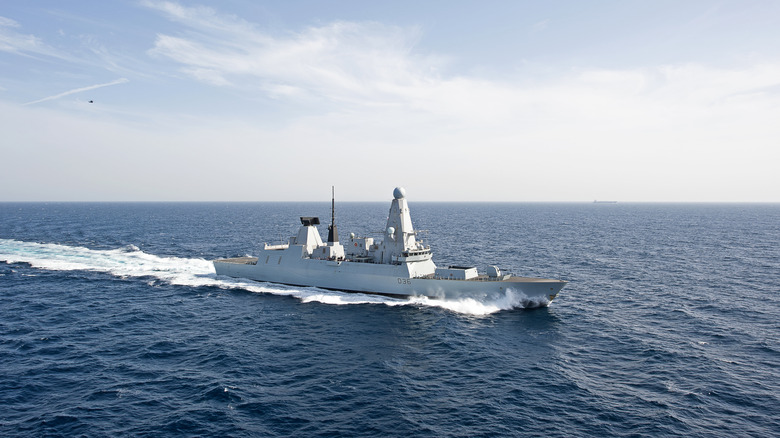
The DragonFire system is far from the only British investment in anti-drone developments, and it will serve as only one part of an ever-expanding defense playbook. For instance, just one month after the laser system reveal, the Ministry of Defense's newly formed U.K. Defence Innovation initiative announced a £142 million program to rapidly escalate the country's development of military drones and defense systems. The program, which will direct funds to over 30 local firms and universities, aims to apply lessons from the use of asymmetric warfare in Ukraine to the British military's technology development pipeline. Other investments this year include the development of an uncrewed submarine dubbed Excalibur, UAVs, unmanned helicopters, and land-based drone programs, as well as an additional £20 million towards laser weapon systems.
The U.K. isn't the only nation to add lasers to its anti-drone defenses. Ukraine, for instance, claims it has developed and deployed its Trident laser system as early as 2024 (via CNN). Israel's Ministry of Defense, meanwhile, recently added its 100-kilowatt Iron Beam system to its famed Iron Dome. The U.S. is reportedly looking to add up to 20 high-energy laser systems to its Army's arsenal (via DefenseNews), recently testing mobile Laser-Oriented Counter-UAS Systems atop its Joint Light Tactical Vehicles. One unnamed NATO partner, meanwhile, reportedly struck a $125 million deal with Australian defense firm Electro Optic Systems to develop its 100 kW high-powered Apollo laser system. Additionally, South Korea, China, Russia, France, and Germany are among the nations looking to adopt the technology. China, in particular, is looking to pair laser technologies with diverse, multi-layered detection, kinetic, and non-kinetic defense strategies.