

RIM Opens Up BlackBerry PlayBook To Support Android Apps
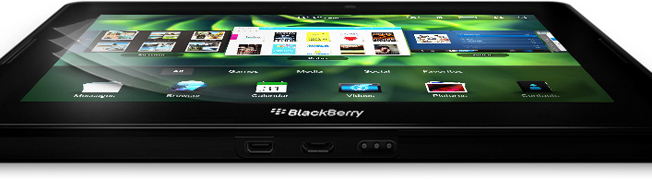
The news we reported exclusively many months ago has just been officially confirmed by RIM — the company will indeed support Google Android apps on its BlackBerry PlayBook tablet and on new QNX-based BlackBerry smartphones moving forward. RIM is also offering a suite of tools for Android developers that will allow them to easily port their existing apps to the PlayBook for distribution through BlackBerry App World. RIM's full press release is after the jump.
RIM Expands Application Ecosystem for BlackBerry PlayBook· BlackBerry PlayBook to support BlackBerry Java and Android apps· Native C/C++ development support added, in addition to HTML5, Flash and AIR support· Support from leading game engines: Ideaworks Labs (AirPlay) and Unity Technologies (Unity 3)· BlackBerry PlayBook becomes a new market opportunity for all the developers who have already created over 25,000 BlackBerry Java apps and more than 200,000 Android apps Waterloo, ON – Developers wanting to bring their new and existing apps to the highly anticipated BlackBerry® PlayBook™ tablet will soon have additional tools and options to enhance and expand their commercial opportunities. Research In Motion (RIM) (Nasdaq: RIMM; TSX: RIM) today announced plans to greatly expand the application ecosystem for the BlackBerry PlayBook. The BlackBerry PlayBook is scheduled to launch in the U.S. and Canada on April 19.RIM will launch two optional "app players" that provide an application run-time environment for BlackBerry Java® apps and Android v2.3 apps. These new app players will allow users to download BlackBerry Java apps and Android apps from BlackBerry App World and run them on their BlackBerry PlayBook.In addition, RIM will shortly release the native SDK for the BlackBerry PlayBook enabling C/C++ application development on the BlackBerry® Tablet OS. For game-specific developers, RIM is also announcing that it has gained support from two leading game development tooling companies, allowing developers to use the cross-platform game engines from Ideaworks Labs and Unity Technologies to bring their games to the BlackBerry PlayBook.Support for BlackBerry Java and Android Apps"The BlackBerry PlayBook is an amazing tablet. The power that we have embedded creates one of the most compelling app experiences available in a mobile computing device today," said Mike Lazaridis, President and Co-CEO at Research In Motion. "The upcoming addition of BlackBerry Java and Android apps for the BlackBerry PlayBook on BlackBerry App World will provide our users with an even greater choice of apps and will also showcase the versatility of the platform."Developers currently building for the BlackBerry or Android platforms will be able to quickly and easily port their apps to run on the BlackBerry Tablet OS thanks to a high degree of API compatibility. The new optional app players will be available for download from BlackBerry App World and will be placed in a secure "sandbox" on the BlackBerry PlayBook where the BlackBerry Java or Android apps can be run.Developers will simply repackage, code sign and submit their BlackBerry Java and Android apps to BlackBerry App World. Once approved, the apps will be distributed through BlackBerry App World, providing a new opportunity for many developers to reach BlackBerry PlayBook users. Users will be able to download both the app players and the BlackBerry Java and Android apps from BlackBerry App World.The BlackBerry PlayBook and BlackBerry Tablet OS are built on the QNX® Neutrino® microkernel architecture with a 1GHz dual core processor and a leading OpenGL solution, which allows RIM to make this incredibly broad platform support possible.BlackBerry PlayBook users and developers who are interested in seeing the new app players for BlackBerry Java and Android apps can see demos at BlackBerry World in Orlando, Florida (May 3 to 5, 2011) (www.blackberryworld.com).BlackBerry Tablet OS Development Tools The BlackBerry Tablet OS already supports an incredibly robust platform with support for Web development standard HTML5, through the BlackBerry® WebWorks™ SDK for Tablet OS, and Adobe® AIR®, through the BlackBerry Tablet OS SDK for Adobe AIR. The BlackBerry Tablet OS is built from the ground up to run WebKit and Adobe® Flash® as well, giving developers a fast and true Web experience to leverage.RIM is also announcing today that the BlackBerry Tablet OS Native Development Kit (NDK), which is currently in limited alpha release, will go into open Beta by this summer and be demonstrated at BlackBerry World. The BlackBerry Tablet OS NDK will allow developers to build high-performance, multi-threaded, native C/C++ applications with industry standard GNU toolchains. Developers can create advanced 2D and 3D applications and special effects by leveraging programmable shaders available in hardware-accelerated OpenGL ES 2.0.Other features of the BlackBerry Tablet OS NDK will allow developers to:
- Take advantage of the QNX POSIX library support and C/C++ compliance for quick and easy application porting and for creating native extensions for both BlackBerry and Android applications
- Easily integrate device events like gesture swipes and touch screen inputs
- Integrate the BlackBerry Tablet OS environment into existing code management and build systems using industry standard Eclipse CDT (C/C++ Development Tools)
- Leverage work done in standard C/C++ to make it easier to bring applications to the BlackBerry Tablet OS
- Find and fix bugs quickly with provided debug and analysis tools
"The response to the BlackBerry PlayBook from the developer community has been exceptional. Our commitment to supporting HTML5 and Adobe AIR development has resonated and spurred developers to create fun and innovative applications for BlackBerry PlayBook users," said David Yach, Chief Technology Officer, Software at Research In Motion. "The upcoming BlackBerry Tablet OS NDK beta will add C/C++ tools to our repertoire and gives developers one of the broadest and deepest platforms to develop on."Gaming EnginesBuilding on the power of the BlackBerry Tablet OS NDK, RIM is working with leading gaming and application development technology providers such as Ideaworks Labs and Unity Technologies to implement their native engines and application development platforms. Developers will be able to take advantage of these engines when building games and other applications for the BlackBerry PlayBook.The Ideaworks Labs Airplay SDK is expected to include support for the BlackBerry Tablet OS soon, making it easy for publishers and developers to use their existing code to bring their games and apps to the BlackBerry PlayBook."Supporting a new OS can be a challenge for developers," says Alex Caccia, President of Ideaworks Labs, "however, integration of the BlackBerry Tablet OS with the Airplay SDK makes this a non-issue. We think this is a far-sighted move by RIM: the BlackBerry PlayBook is a great device for games and applications, and combining this with content distribution via BlackBerry App World brings an exciting new ecosystem for developers."RIM has also been working closely with Unity Technologies, providers of the highly popular, multi-platform Unity development platform and Union, the firm's games distribution service. Through Union, dozens of high-quality Unity-authored games are slated to make their way to BlackBerry App World for the BlackBerry Playbook."With a sharp focus on the multimedia experience, very powerful hardware, and fantastic games in the pipeline, the BlackBerry Playbook has all the right ingredients to be a mainstream hit," said Brett Seyler, GM of Union at Unity Technologies. "Through Union, Unity developers have an opportunity to reach a new audience and grow with another great new platform."AvailabilityThe new app players for the BlackBerry PlayBook are expected to be available from BlackBerry App World this summer. More information and demonstrations of the new app players will be shared at BlackBerry World. The BlackBerry Tablet OS NDK will be available in beta later this year and will also be showcased at BlackBerry World.